

The $138K selfie budget
Paul Xue ·

The short answer
The $138K selfie budget is an estimated media-equivalent value, not measured revenue or actual campaign spend. Its assumptions produce $138,240 a year: 120 posts × a 10% chance of 240,000 views × $48 per thousand views. The business test is whether that attention reaches suitable buyers and produces qualified pipeline.
For a week in August 2026 the most talked about company in SF tech was Corgi. Corgi sells commercial liability insurance. Nobody was talking about insurance.
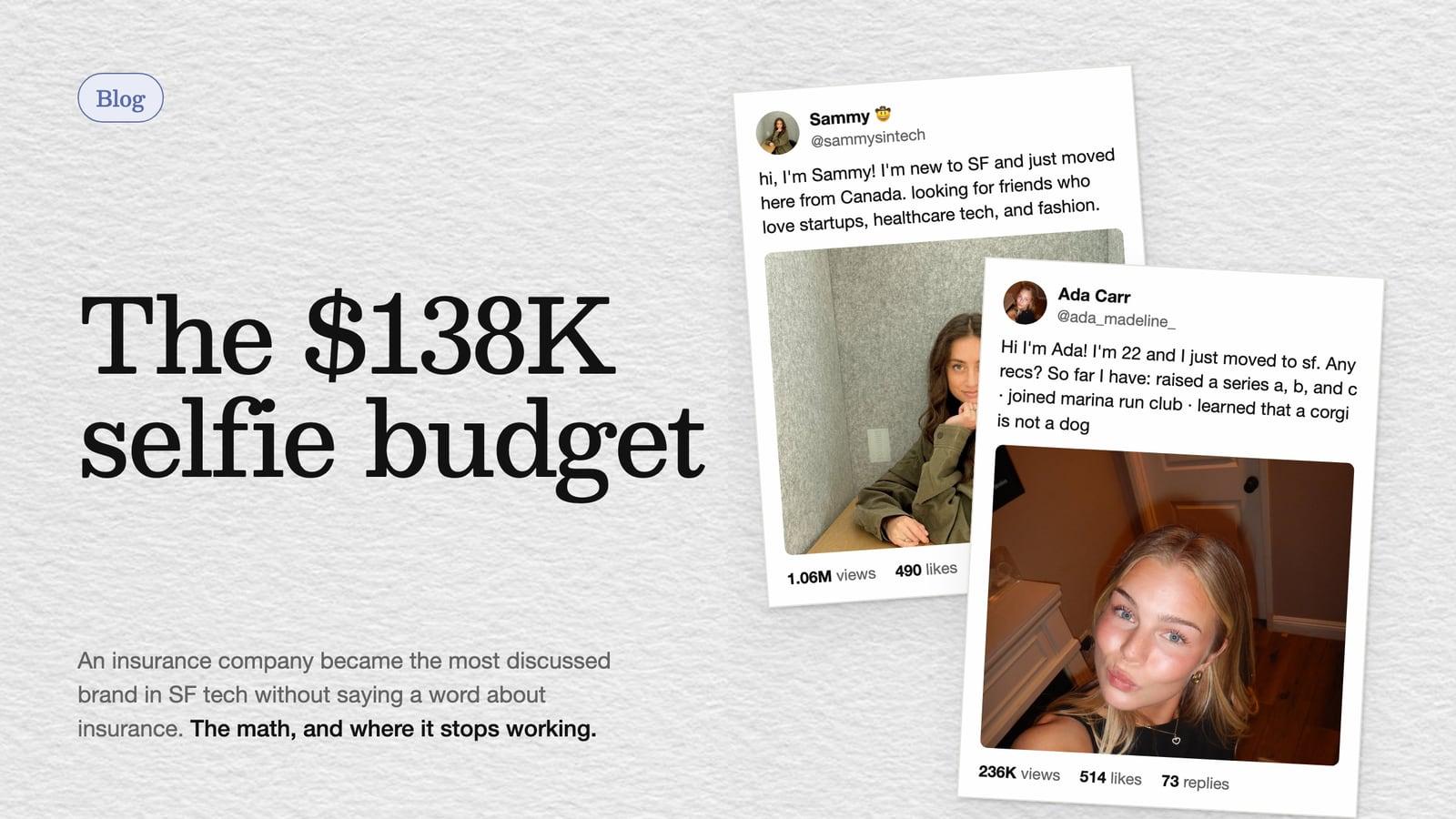
They were talking about the Corgi girls. Young women in growth roles, all posting the same post: aerial selfie, "hi, I just moved to SF," no mention of an employer for another four posts. The Sammy post Georgia Witchel opens her essay with is at 1.06M views. The essay did 1.1M.
What is the $138K number?
The estimate uses a 10% chance of 240,000 views and an assumed $48 CPM. Across five people posting twice a month for a year, that produces $138,240 in modeled media value. It is not measured revenue, and staff time and production costs still count.
Why does it work on this crowd?
Because of who is buying. Corgi's founders are 26 and 24, the same age as the people they are marketing to. A bunch of 20-something guys running AI startups in SF are wired to notice a hot girl posting about her company. There is nothing sophisticated about it. It is primal. Young guys with money, status and hormones are easy marks for an attention play, and everyone involved knows it.
The age thing is not a guess. The median YC founder was 24 by the end of 2024, down from 30 in 2022, and 2025 was the first year most of the batch was 25 or under. These posts land on the exact demographic running half the scene. Looks buy attention, attention buys pipeline and a brand, and the product does not have to show up until post five.
Where has this happened before, and did it work?
Anywhere the audience is young, male heavy and holding cash. The record is mixed, which is the useful part.
Finance worked, for a long time. Hedge funds hired attractive young women for marketing and investor relations, the industry called them "money honeys," marketing directors cleared up to $2M a year with bonus, and some funds treated modelling agencies as temp agencies. People called it shallow the whole time. The incentives did not move an inch.
Crypto had huge wins and total disasters. Women on crypto Twitter turned a following into paid promotions, token deals and enough gains to quit their jobs. Then came rug pull accusations, harassment and coins down 90% overnight. The HAWK Tuah token went from a $500M market cap to under $60M in minutes in December 2024, and the lawsuit followed.
Booth babes at tech and auto shows were a clear failure. Spencer Chen, then running marketing at Frontback, A/B tested it in 2014: the booth staffed by his own team pulled over 550 leads, the one staffed by models got a third of the foot traffic and less than half the leads, and the leads it did get had no budget and no authority. The industry dropped the practice because it did not make business sense, not because anyone won the argument about taste.
Corgi is still in the "working" column: over $480M raised, a $1.3B valuation in May 2026 and $4B by July, partly on this attention. Also a code theft accusation from Papermark, and a hot-or-not site built from its female staff's LinkedIn photos that pulled 200,000 visitors before Corgi's lawyers killed it. The pattern across all four: it prints money short term when your audience is young guys with cash, and it is fragile.
Why is everyone so angry?
Society is not learning anything from this. It is adapting. The backlash is the older guard and the engineer types realising their technical prestige is getting outbid by vibes and looks. Software got cheap to build. Selling it did not. So the market marked social fluency up and engineering prestige down, and the people holding engineering prestige got loud. The young guys holding the chips are happy to play the game as it is, because the game is being played at them.
Does it actually pay?
The commercial question is whether the people paying attention are suitable buyers. A format can win notice while generating few qualified opportunities. That distinction matters more than the headline view count.
One marketer in her replies: "Nothing wrong with being hot for marketing, but it's a hack and it's not what I'm on twitter for," and then he muted the accounts. That is the cost nobody puts in the CPM, and it is why authenticity beats advertising on Reddit: people can tell when they are the product. A format cheap enough to parody in ninety seconds, and one post in her essay is a parody, is cheap enough for the tenth insurance company to copy. The tenth one gets muted on sight. Corgi got the trend because Corgi was first. Nobody gets it twice.
The calculation, with the assumptions visible
Five people posting twice a month produce 120 posts a year. At an assumed 10% chance of reaching 240,000 views, expected annual views are 2,880,000. Divide by 1,000 and multiply by an assumed $48 CPM, or cost per thousand impressions, to get $138,240.
This treats unsuccessful posts as having zero value and assumes the same success rate throughout the year. It does not establish unique reach, buyer fit, paid-media equivalence or incremental sales. At a 5% success rate the same model produces $69,120; at 20% it produces $276,480. Those are sensitivity examples, not forecasts.
Test qualified demand before scaling the format
Define a qualified inquiry before publishing: target customer, relevant problem, buying authority and a plausible budget. Use the same definition for a more conventional post and the attention-led format. Record staff time, inquiries, qualified inquiries and opportunities, not just views.
Where links are appropriate, give each campaign a distinct tag. Where they are absent, ask how buyers first heard about you and what prompted the inquiry. Keep an attribution-unknown category. A small test can reveal poor audience fit, but it cannot isolate the format from every timing and distribution effect.
What I take from it
We build products for clients and then get asked how to sell them, so I have watched "it will find its way to market" cost real money. Refusing to do distribution because it feels beneath the product is a tax you pay with the product. A face with a point of view beats a logo with a feature list. The face does not need a swimsuit. It needs to be someone the buyer would recognise in a thread.
What the Corgi girls do not prove is that views pay. These views are zero-click by design, the post never names the company, so all they buy is recall. We have lived a smaller version: a client of ours, an app development agency, had a post pass 1M views last year and inbound went up 10x the next week. Qualified sales did not move. The extra volume was students, other agencies and founders with no money, and three weeks of qualifying went into leads that were never going to sign. What changed was "1M views" on a slide.
If you run this play, draw the line from post to qualified pipeline before the first selfie. Nobody draws it for you after. And be nice to the women doing it, they are doing their job while a CEO tells them to post more. The CEO owes them the harder half: a product good enough that when the fifth post finally names it, someone buys.
Next, read What is Zero-Click Marketing? Why Reddit is the Best Channel for It.
Frequently asked questions
Is $138K the amount spent on selfies?
No. It is a modeled media-equivalent value using assumptions about posting frequency, reach, success probability and CPM.
What should replace views as the success metric?
Track qualified inquiries and opportunities alongside reach and total campaign cost. Views remain useful context, but they do not establish commercial return.
Common questions
Is $138K the amount spent on selfies?
No. It is a modeled media-equivalent value using assumptions about posting frequency, reach, success probability and CPM.
What should replace views as the success metric?
Track qualified inquiries and opportunities alongside reach and total campaign cost. Views remain useful context, but they do not establish commercial return.
How we research, write and correct these posts is in our editorial policy.

