

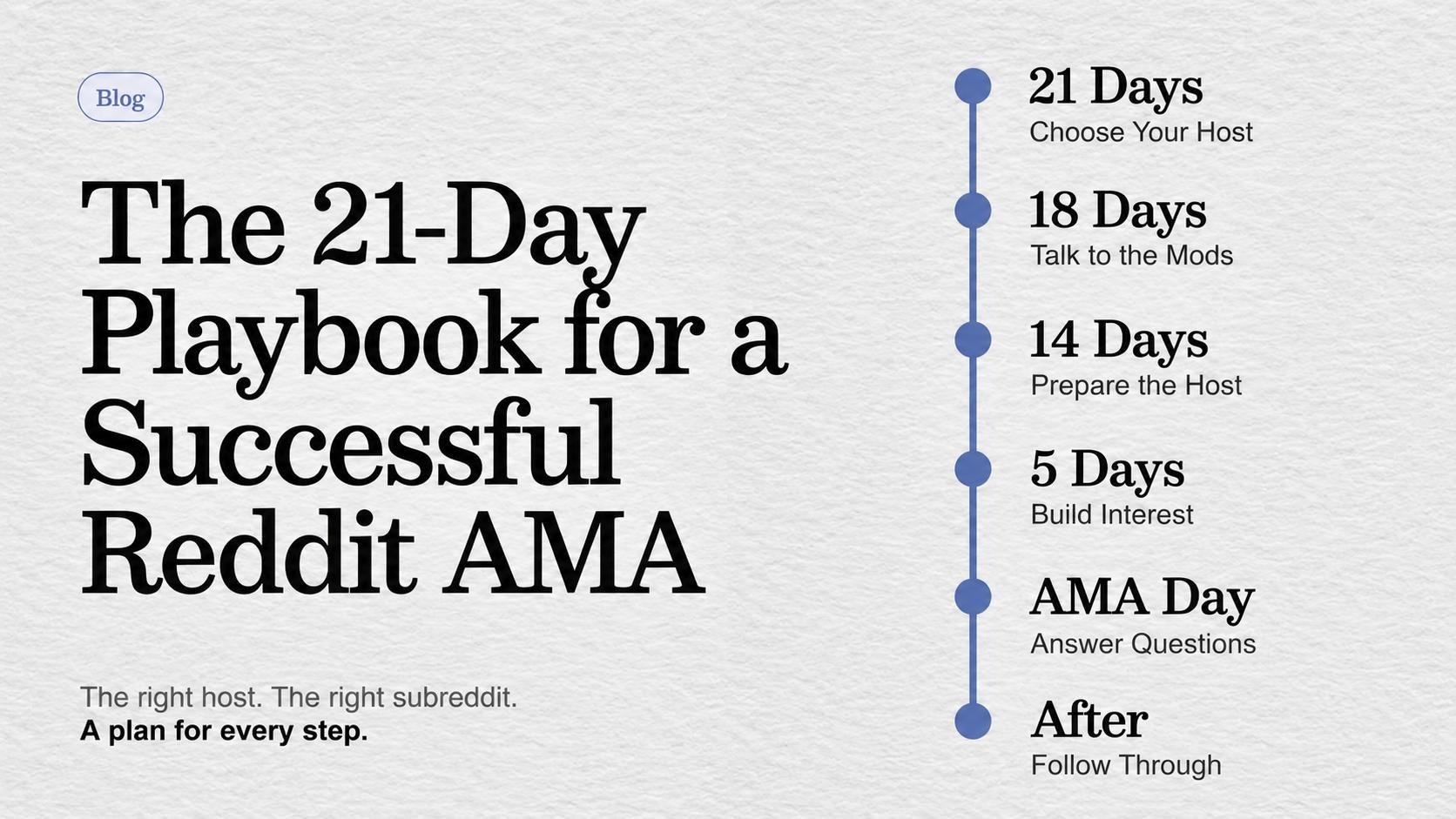
The 21-Day Playbook for a Successful Reddit AMA

The short answer
A successful Reddit AMA starts with a topic the community wants and a host who can answer from experience. Use the 21 days before the session to coordinate with moderators, prepare evidence and assign live roles. Afterward, answer outstanding questions and turn recurring concerns into useful documentation.
A Reddit AMA, short for “Ask Me Anything,” is a conversation where a host introduces themselves and answers questions in the comments. It can look deceptively simple. Pick a date, invite questions, and start answering. But by the time the first question appears, most of the decisions that will determine whether the AMA works have already been made.
The right host can give a community access to expertise they genuinely want. The wrong topic can make the entire thing feel like a product launch disguised as a conversation. Poor preparation can leave a founder scrambling when difficult questions arise, while too much preparation can produce answers that sound like they were approved by three departments before being posted.
The best Reddit AMAs feel spontaneous because the preparation happened beforehand. The host understands the audience and can answer difficult questions without sounding scripted. Here’s how to use the three weeks before your AMA to get there, starting with the person doing the answering.
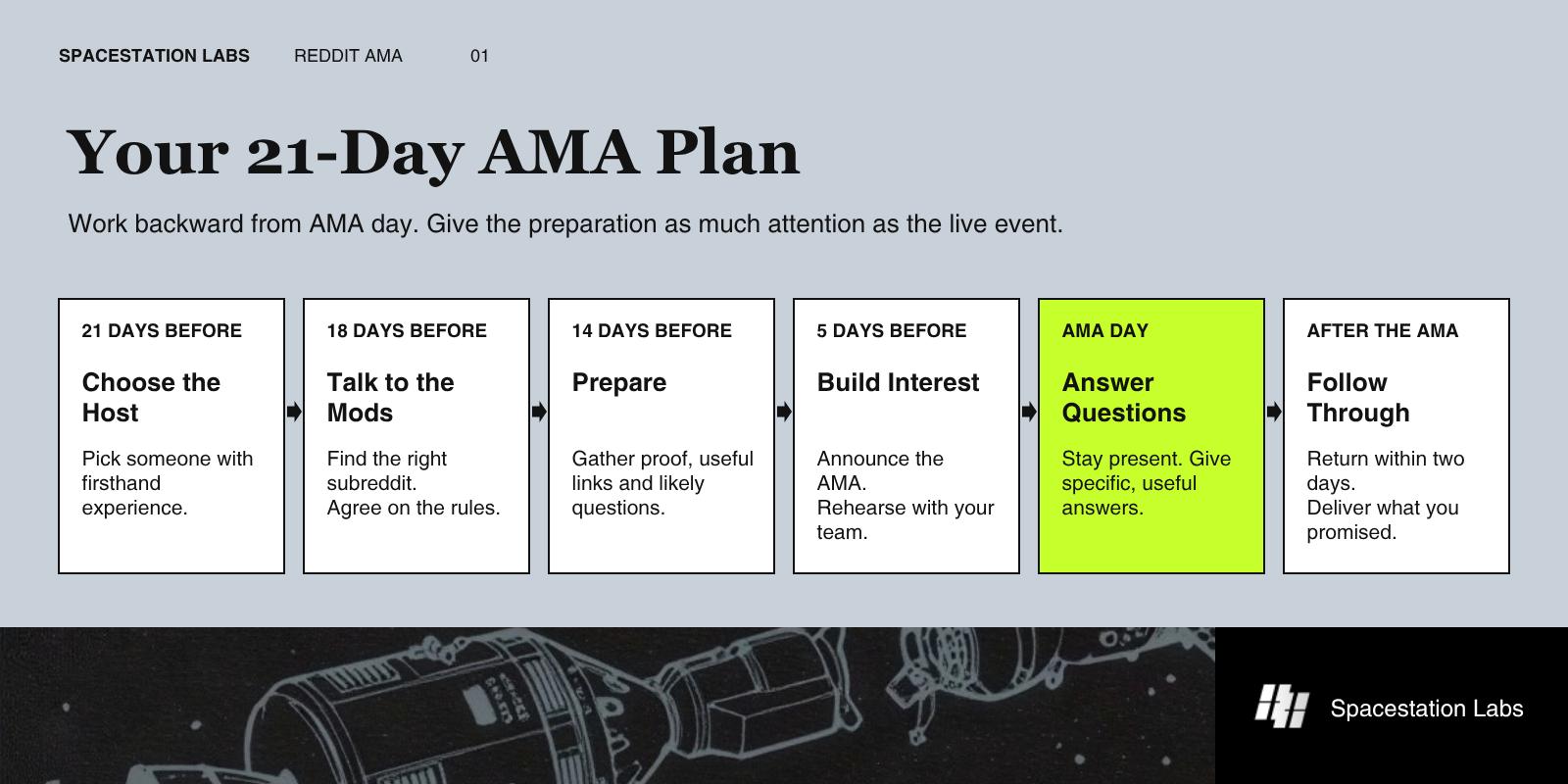
21 Days Out: Give People a Reason to Ask
The first question to answer has nothing to do with scheduling: why would this particular community want an AMA with this particular person?
A recognizable title or company name is not enough. The host needs to offer something the audience values, whether that is unusual expertise, firsthand experience, access to someone who normally feels inaccessible, or a perspective on a subject the community already discusses.
The same principle applies to the topic. Start with what the subreddit cares about rather than what the company wants to announce. If the business is launching a new product, for example, the AMA does not necessarily need to revolve around the launch. There may be a much stronger conversation around the problem the product solves, lessons learned while building it, or changes happening across the industry.
Before moving forward, define what a successful AMA would look like. That could mean meaningful questions from the right audience, productive discussion around an important topic, useful customer insights, or stronger relationships with a particular community.
Before you commit, ask one more thing: can this person answer questions the subreddit actually cares about? If the answer is yes, you have a starting point.
18 Days Out: Talk to the Mods Early
Every subreddit has its own culture, rules, expectations, and tolerance for brand participation. Look at recent discussions and previous AMAs in the subreddits you’re considering. Are people asking questions your host can answer? Did similar AMAs get thoughtful responses? Check the rules and pinned posts for any AMA requirements. A smaller subreddit full of the right people can be a better fit than a huge one with little interest in your topic.
Reach out to moderators through Modmail well in advance. Introduce the proposed host, explain the topic, and ask what the community typically expects from AMAs. Some moderators may suggest a better format or timing, while others may flag topics that are unlikely to resonate or recommend adjustments based on what has worked before.
That feedback is valuable. Moderators see what generates thoughtful discussion, what gets ignored, and what immediately feels promotional. Treating them as partners can help the AMA feel like it belongs in the community rather than being dropped into it by a marketing team.
Keep the first message simple:
“Hi mods, I’m [name and affiliation]. [Host] would like to answer questions about [specific topic]. They have firsthand experience with [relevant work]. We think this would help your community because [reason tied to existing discussions]. Would an AMA fit your rules? If so, what proof, timing, and announcement process do you require?”
Agree on the date, time zone, proof of identity, and announcement process before promoting the session. If the moderators need more lead time, move the date. The 21-day plan should work around the subreddit’s schedule.
14 Days Out: Prepare for the Hard Questions
If there are questions you hope nobody asks, assume somebody will.
Before the AMA, search Reddit for existing conversations about the company, product, founder, and competitors. Look at recurring complaints, misconceptions, pricing objections, product limitations, controversial decisions, and comparisons that appear repeatedly. Then prepare the host.
Preparation does not mean writing approved responses for every possible scenario. Put a short briefing together so the host can find the facts when they need them:
- Recurring complaints, objections and questions about the company or product.
- Facts and context behind the decisions people are likely to question.
- Supporting links, documentation and data the host can share.
- A person who can quickly check details or follow up on an unanswered question.
There is a significant difference between being prepared and being scripted. Reddit users can usually tell when someone is answering from experience and when they are delivering a polished PR response. The goal is to give the host enough context to speak naturally, including when the question is uncomfortable.
For more on handling criticism, read How to Handle a Reddit Backlash.
5 Days Out: Build Interest Before AMA Day
Announce the AMA on the schedule you agreed with the moderators so people have time to discover it and prepare questions. Then use your existing channels to make sure the right audience knows it’s happening. Make the date, time zone, and link easy to find.
Draft the title and introduction before you post. Tell people who the host is, what they know, and what they’re there to discuss. You can start with these and make them sound like you:
Title: I’m [name], [role] at [company]. I’ve [relevant firsthand experience]. Ask me anything about [topic].
Introduction: Hi, I’m [name]. I work on [specific area] at [company], where I’ve [relevant experience]. I’ll be here on [date] from [start time] to [end time, time zone] to answer your questions about [topics]. [Add the proof agreed with the moderators.] Ask me anything!
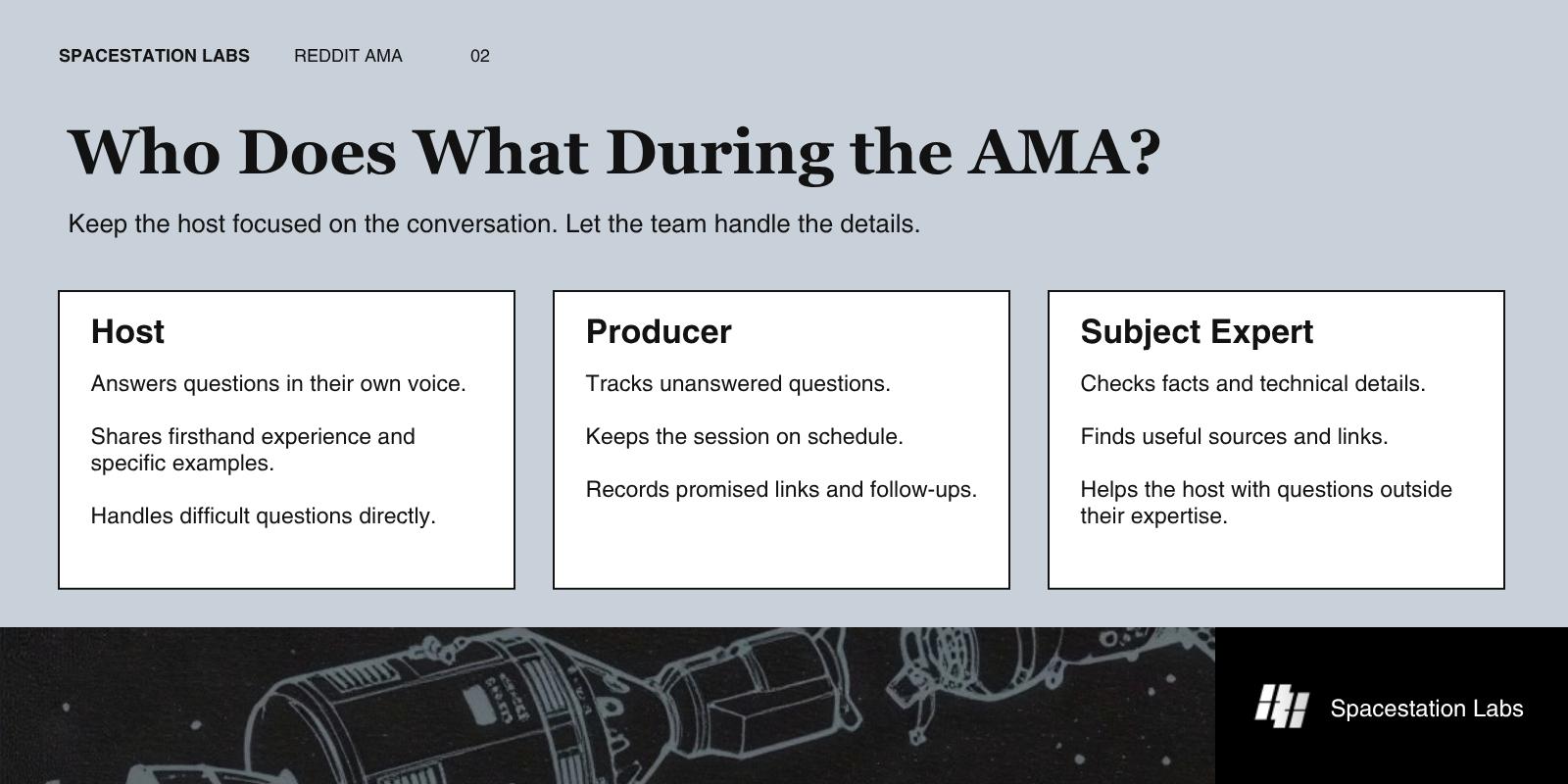
Get the team’s jobs clear, too. The host answers from experience. A producer tracks unanswered questions, timing, and promised follow-ups. A subject expert finds documentation or fact-checks. One person can cover more than one job. Review early questions as they arrive so you can spot themes without pre-writing the conversation.
Before AMA day, check that the host can log in, find the post, and reply from the right account. You don’t want the first question to be about a forgotten password.
Promotion should bring relevant people into the room, not manufacture engagement. The objective is a useful discussion with the right community, not the largest possible audience.
AMA Day: Keep the Conversation Real
When the AMA goes live, the focus shifts from preparation to participation. The host should be ready to engage with the conversation as it develops, including the questions that are difficult, unexpected, or critical of the company.
Give difficult questions the same attention as the easy ones, providing specific answers and enough context to explain the decisions behind them. When someone raises an interesting point, engage with it thoughtfully rather than steering the conversation back toward the product or a predetermined message.
Most importantly, pay attention to the questions people choose to ask. An AMA is one of the rare opportunities for a company to see what an audience wants to know when the company is not controlling the interview.
The strongest conversations may move in directions the team did not anticipate. Let them. If every answer somehow leads back to the same three marketing messages, people will notice.
Reply directly to each question so readers can follow the exchange. Use the AMA’s Answered and Unanswered views to help track what’s been covered, and check back for follow-up replies. Have your producer keep a short list of anything you’ve promised to look up or share.
When it’s time to finish, add a sign-off to the post. Thank people for joining and tell them when you’ll return with any outstanding answers. That way, nobody is left wondering whether you’re still there.
After the AMA: What Comes Next
Within the next two days, return to unanswered questions and share any resources you promised. Give each follow-up an owner so it actually happens. Then look beyond individual answers and identify the patterns that surfaced across the discussion.
Review the thread and ask:
- Which questions came up repeatedly?
- What objections or concerns surprised you?
- How did people describe their problems in their own words?
- Which answers generated the most follow-up discussion?
- What did people ask that your website, sales materials, or documentation do not answer particularly well?
Those patterns can inform FAQs, sales enablement, product messaging, future content, and even product decisions. Strong answers can be repurposed into follow-up content, while unanswered questions create natural opportunities to return to the community with something useful later.
Measure substantive questions, answered questions, useful follow-ups, and recurring buyer concerns. Log any qualified inquiries separately. A small, relevant AMA can be useful without producing a high upvote count.
Your AMA Launch Checklist
- 21 days out: choose the host, topic, audience and success criteria.
- 18 days out: choose the subreddit and agree on the format, proof, and timing with its moderators.
- 14 days out: prepare the host’s briefing, supporting links, and help for difficult questions.
- 5 days out: finalize the post, announce the AMA and assign support roles.
- Before you go live: check the account, post, time zone, and host’s availability.
- AMA day: answer questions, track follow-ups, and sign off clearly.
- Within two days: deliver promised answers and review what you learned.
What a Great AMA Leaves Behind
Perhaps that is the best measure of a great AMA: people came for access, stayed for the conversation, and left behind something worth reading even after it was over.
How we research, write and correct these posts is in our editorial policy.

