

What Share of AI Citations Comes From Reddit? Three Programmes, 1,367 Citations
Paul Xue ·

The short answer
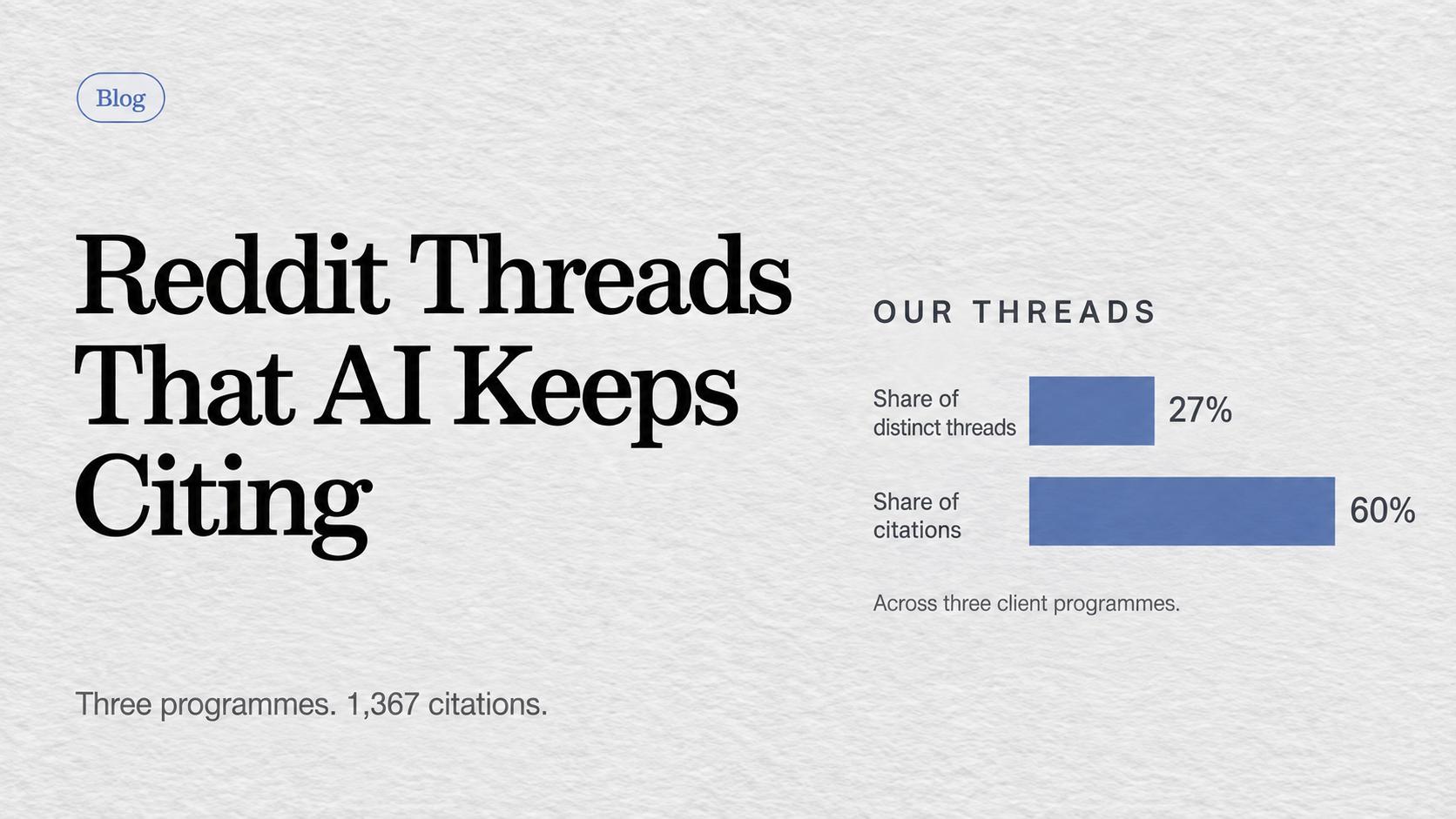
Across three client programmes we tracked 1,367 citations in AI answers. Threads we placed were 27% of the distinct Reddit threads the engines cited but took roughly 60% of the citations, so a cited thread is worth about twice its share. First citations landed between 7 hours and 2 days after publishing, not the weeks or months that ranking on Google takes.
A cited thread is worth about twice its share
Across three client programmes we tracked 1,367 citations in AI answers. Our threads were 27% of the distinct Reddit threads the engines cited. They took roughly 60% of the citations.
That ratio is the number worth arguing about, because it contradicts how most teams budget for Reddit. The instinct is to treat citations as a volume problem: publish more threads, get cited more often. What the data says is that engines return to a small set of threads repeatedly, and being inside that set is worth more than being numerous.
The three programmes
All three are organic. All three are published on this site as case studies with their own numbers, so nothing here is a figure you have to take on trust.
Cleverific, Shopify order editing. 913 citations in three weeks. 62% of the Reddit citations in those answers pointed at threads we placed. Of the 210 distinct Reddit threads the engines cited, 49 were ours. First citation 7 hours after publishing.
Papermark, virtual data rooms. 266 citations in three weeks. 56% of the Reddit citations were ours. 24 of the 58 cited threads were ours. A position-1 citation 2 days after publishing.
Vielight, brain photobiomodulation devices. 188 citations. 54% of the Reddit citations were ours. 12 of the 47 cited threads were ours. First citation 40 hours after publishing.
Read the thread counts against the citation shares and the pattern is the same in all three. Cleverific owned 23% of the cited threads and took 62% of the citations. Vielight owned 26% and took 54%. Papermark is the closest to parity at 41% of threads for 56% of citations, and it is also the smallest thread pool of the three.
Citation latency is hours, not months
The slowest first citation in this set was two days. The fastest was seven hours.
This is the finding that surprises people most, because it does not match how Reddit works for search. Ranking on Google through Reddit takes weeks or months. Getting quoted in an AI answer took less than a working day in two of these three programmes.
The reason is mechanical rather than flattering. Answer engines retrieve at query time from an index refreshed far more often than a ranking algorithm reshuffles. A thread does not need to age or accumulate authority to be quoted. It needs to exist, be relevant to the question, and be legible.
That cuts both ways. A bad thread about your brand is quotable just as fast.
One post can carry a campaign
Two of our programmes were a single post each.
Specode published one post in r/sysadmin about the disaster the product was built to prevent: 309,000 impressions, 1,049 upvotes, 293 comments from hospital IT staff.
Topflight published one post: 983,000 impressions, 2,763 upvotes, 1,326 comments from real buyers.
One post, in both cases, was the whole campaign.
The published research on AI citations tends to point the other way, noting that the median cited Reddit post is modest, often single-digit upvotes. Both things are true and they are not in tension. A thread does not need scale to be cited. But scale is what produces the comment volume that makes a thread worth citing repeatedly, which is the multiplier in the first section.
What reach costs when you pay for it
For contrast, the one paid programme in this set. Wafer, in two weeks: 1,335 sign-ups at $0.88 each, $0.04 per click, and a 15x increase in daily tokens processed on OpenRouter.
That is the honest comparison to hold against the organic numbers. Paid buys reach on a known unit cost and stops when you stop. Organic citations compound and cannot be bought at any price, which is the tradeoff rather than a reason to pick one.
What these numbers do not tell you
Three programmes is not a study. It is what we can currently prove, published so it can be argued with.
The specific limits worth naming. The three programmes sit in unrelated categories, which is good for generality and bad for precision, because we cannot separate category effects from anything we did. The measurement windows are not identical: two are three weeks, one is not recorded. Share of citations is a share of a pool that the engines choose, so it moves when the pool moves, not only when we do. And nobody outside this dataset can reproduce it, which is the weakness of every proprietary benchmark including this one.
We would rather publish the ratio with its limits attached than round it into a claim.
How to run this on your own brand
You do not need our tooling to get a first read.
Write down the ten questions a buyer would ask an AI before choosing in your category. Run them across the engines your buyers actually use. For each answer, record which sources were cited, how many of them are Reddit, and how many of those Reddit threads you have any presence in.
That last count is the number that matters. It is usually zero, and it is the gap this whole discipline exists to close.
Common questions
How quickly can a Reddit thread get cited in an AI answer?
In this dataset, between 7 hours and 2 days after publishing. Answer engines retrieve at query time from a frequently refreshed index, so a thread does not need to age or accumulate authority the way it does to rank on Google.
Do you need a viral post to get cited by AI?
No. Published research consistently finds the median cited Reddit post is modest, often single digit upvotes. Scale is not what earns the citation, although it does produce the comment volume that makes a thread worth citing repeatedly.
How many Reddit threads does it take to dominate a category's AI answers?
Fewer than most teams assume. Across these three programmes the clients owned 27% of the distinct Reddit threads the engines cited and took roughly 60% of the citations.
Can you buy AI citations?
No. Citations are produced by engines retrieving public sources at query time. What you can influence is whether accurate, useful threads about your category exist for them to retrieve, and whether you are present in them.
How we research, write and correct these posts is in our editorial policy.

